Monday, January 26, 2015

More Mary Grace and the Cavalry


Update: There was more than one Russell I discovered today when I was scanning in more of Mary Grace's scrapbooks. The war years must have been tough because she didn't exactly put them together in order. That's about all the blame I can pass on to her for mixing up the Russells. The Russell in the South Pacific was Russell Bosley as he told her or perhaps it was Bosler. He was born in 1919 in Watkins Glen, New York. She went with him to a winter formal on January 29, 1944. By February he had been sent to the South Pacific. He sent her the photos from there the following January.
Russell Bosley and Mary Grace
Winter Formal, January 29, 1944
Topeka

Russell Bosley, Staff Sergeant
in the Army Air Corps
   
So to those of you who felt that men didn't serve in both the European theater and the Pacific theater, apparently you were right--at least in this case. I must admit I didn't think the Russell in Topeka in 1945 looked that much like the Russell in the South Pacific, but it wasn't enough to stop me from publishing the blog. It was, though, enough to keep me from sending the photos or copies of the photos to Russell Hains' survivors. 

Mary Grace spent a lot of time at the USO, dancing with the GI's and helping to distract them from the war. Her mother gave her this cartoon, saying it reminded her of Mary Grace. She kept their photos and mementos through the war years, adding comments like, "I didn't even dance with this 'little guy'." Among these are nearly 20 photographs, Russell Leroy Hains sent her from his posting with the 5th Bombardment Group in the South Pacific.
Cartoon from 1944
The things you're saying to these boys
sounds pretty serious -- I don't want a 
troop of soldiers marching in here to quarrel
over you!
       According to his obituary in January of 2004, he earned a Bronze Star and Purple Heart in Europe during World War II, but the article doesn't mention his time in the South Pacific. To me the Russell Hains in the obituary is the one whom Mary Grace knew. There are records that indicate he was mustered out of the army at a hospital in Topeka in September 1945.
"A picture of our pet parrot, George. That's me
beside him. Nice tan don't you think."

       
     These photos are a sampling from what he sent her. I haven't been able to pinpoint where he was stationed, but it may have been in the Solomon Islands. Clearly somewhere warm as these are dated either December 15 or Christmas Eve 1945. Russell was born in August 1924 so that would make him only 20 years old.
December 24, 1944
Another view of our celebrating Christmas
in the Islands.

December 15, 1944
E. Moodie, our ballgunner with bananas
and tree.


Russell saw Mary Grace when he returned to the states in 1945. On this day in August he and Mary Grace posed for several photographs. In her My Life, Mary Grace wrote that she almost got engaged to one of the soldiers she met through the USO. At this point, no one knows or remembers which one of her suitors she meant, but she has more photos of Russell than anyone else. She and Ray had been dating off and on by then for almost four years with engagements occurring between them every so often. They eventually married in July 1946 less than a year after this. In Mary Grace's scrapbook, near the photos of Russell in Topeka, is a clipping describing the 30th McClenny reunion, including the information that Mary Grace Burkhardt attended. Russ left Topeka soon after these photos were taken. The last reference of Russ is a postcard from him saying he was on his way home to Philadelphia.
December 15, 1944 - Solata,
my radio operator and me.
Things that look like rocks are coral.
Edna and Russell
August 1945 Topeka

Russell and Mary Grace
August 1945 Topeka


Wednesday, January 14, 2015

The John and Edith McClenny Family Home - 60 Years Apart

Edith Davis and John McClenny
Wedding day, November 9, 1890
      John McClenny married Edith Lorraine Davis on November 9, 1890 at the home of the Edith's parents according to the Farmer's Vindicator. It could have been the home of her mother, but her father, James Young Davis, had died in 1884. John and Edith, who grew up 300 miles apart, may have known each other because their families were somewhat intertwined. John's father, WC, grew up in Bond County, Illinois where Edith's family, the Davises also lived. John's aunt, Mary Melissa, married Edith's father's half-brother, Amos Huntington Davis. As a sidelight, Amos, spent the Civil War as a member of the 20th Illinois Infantry band.

     Their first child, Curtis, was born in August 1891 in Jefferson County, but their next two children, Otis and Valla, were born in Bond County, Illinois. At the beginning of 1898, they returned to Jefferson County. In January 1899 they took out a mortgage on 10 acres near present day 150th St and Marion St in Jefferson County.


From the left, John holding Goldie or Helen as we knew her; Otis, Curtis, either Edith's mother, Mrs. Davis
or her sister, Sada Davis; Valla and Edith outside their home in 1901.
Both Helen and Vala started with two l's, but they both dropped the second l at some point.
McClenny Home from a different view from the back after an addition. This photo was dated 1914.

     The McClennys lived there until about 1917 or 1918, perhaps, five years after John's death in 1913. Below is a home movie from 1965 when Helen and Vala revisited their home, nearly fifty years after they last lived there. John & Edith's home on Google maps The description of their land is 10 acres of the northwest quarter of the northeast quarter of section 35 in township 8 of range 18 east of the 6th meridian. It's close to the intersection of 150th St and Marion Road in Jefferson County.


Sunday, November 30, 2014

Burkhardt Portrait 1928


    This portrait photograph was in the notebooks Mary Grace put together from photos that Edna had. I don't know why E.A. is not in it. I thought maybe it was a gift for his fortieth birthday, but that would have happened in September 1926. Maybe Helen remembers what the occasion was.


From left: Helen, Ethel, Mary Grace, Allan, Edna
Portrait labeled 1928

     This was in the notebook I was working on and left unattended on the floor. Buster found it and decided to add his own comments. Fortunately I had already scanned in this portrait and the other photographs and pages he felt worthy of his comments.


Friday, November 21, 2014

A Baptist, a Bicycle and a Bootlegger and Possibly a Vindictive Wife

    In June 1911, a 30-something Baptist preacher blew into Topeka on a reputation as an orator, [oddly considering it was based on his finishing 6th in an oratory contest with 12 contestants] For nearly the first year of his tenure at the First Baptist Church, he showed a progressive bent i.e. support for women's right to vote and was in the forefront of the Men and Religion Forward Movement, an attempt to address society's ills through Christianity.

     But then came a morning in late April 1912. The Rev. Robert Gordon describes it:


The bright sunshine of this morning was doubly delightful after a gloomy Sunday and I rolled along, on a round of duties, in unusually exalted spirits all unconscious of the dark impending future . . ..

From the east I came up on the north side of Eighth and wishing to proceed southward on Kansas made for the west side of the street. Having learned in the geometry long ago that the sum of any two sides of triangle is always greater than the other side, I was following the diagonal when startled by a raucous shout. Someone seemed to be in serious distress--drowning or burning up. Looking around I saw a tall. .policemen in the middle of the street, swinging a billy and shouting.
I stopped to inquire into the occasion of his excitement when metaphorically speaking he ‘put me into the box.’ Solemnly he asked name and address and put that data down in a book, telling me I was to appear before the police judge at three o’clock. A crowd on the sidewalk seemed to be enjoying life immensely.

At court this afternoon, I found myself charged with ‘cutting corners’ and paid a fine of two dollars. I tried to pay by check that I might have the instrument framed to pass on to my progeny as a proof positive of the fact that law is law in Topeka. But the official wouldn’t accept a check. I asked for a receipt thinking that would be a curiosity, but the man in blue and shining buttons wouldn’t grant that request. He said ‘You are the receipt. If you didn't pay you wouldn’t get out.’ I guess he was right on that. You may say that on Sunday night I expect to speak on Law Enforcement in Topeka.
   You might say that the Reverend didn't take it well, felt particularly embarrassed and ridiculed. And then began a nearly eight-year off and on fight with the police and city officials.

    The Reverend had a tradition of giving a sermon on Sunday night and on May 5, the Sunday after his ticketing he gave one listing the various sins of the city police department and the mayor. Starting with what I would say was sarcasm, he complimented the department on their enforcement of the jay-driving ordinance, but then the screed began:

According to the Capital,  Rev. Gordon flayed these same officers of the law for alleged indifference to lawlessness which he declared was flourishing in the city. The Rev. Mr. Gordon in his sermon at the First Baptist church, on “Law Enforcement in Topeka,” claimed that hoodlumism, neglect of duty the the officers, gambling, cigarette smoking, and the social evil [prostitution] are rampant. He read a list of names which he termed “undesirable citizens,” who are holding federal licenses for wholesale or retail of liquor.
    On the list of undesirables was one Fred T. Walker, Edna's older brother, third child of Betsy and Edward. He was actually on the list twice - because he had a permit for both wholesale and retail sale of liquor. Kansas had always tried to regulate liquor, but up until 1909, pharmacists were allowed to sell it to persons presenting prescriptions. But in 1909 the law was tightened because there was a belief that pharmacists were far too gullible and filled prescriptions even if the person came in with a new one every day. So this is where it gets a bit cloudy because apparently someone like Fred could get a federal permit, but the sale was still illegal.

Fred, standing, Percy seated holding Bud and
to the right of Bud are Pearle and Lucille
    As one might imagine city officials didn't take kindly to the Reverend's sermon especially since one young officer lay dying while the Reverend gave his harangue. The officer had tried to arrest someone at the Union Pacific depot and in the struggle he was shot.

     The mayor stated to the Capital that he found the Reverend's words unfortunate. But Gordon was not apologetic. Mayor Billard believed the reverend's remarks were made in very bad grace. . . .The charges made by the reverend gentlemen really are not worth answering. They are absurd. For instance, he gives a list of names of what he calls “undesirable citizens” who really are good, honest druggists in this city.. . . Because the police arrested and fined a minister it is no attack on the churches in Topeka.


Continuing the confrontation, the Reverend replied in kind, speaking of the mayor's choice for police chief who was involved in the melee where the young officer was wounded. He had courage you say. You ought to remember there is a clear line of demarcation between physical courage and moral courage. It wasn’t necessary for him to capture a  boy murderer to convince us he had nerve. Any man who, with his record, would accept that office, certainly has nerve.


     Fred, having made the list of undesirables, became the only one to have his drugstore raided. On Thursday, May 16, 1912, the police searched his drugstore and confiscated 7 half pints and ten pints of whiskey, three quarts and two pints of wine, and 20 bottles of beer.Liquor Is Secured in Drug Store Raid The question becomes why was his drug store raided? And the answer may lie in the following want ad that Fred ran in the Capital in early April 1912:

From the April 3, 1912 Topeka Daily Capital
    There is no evidence that I've found that says this is why he was raided, but there seem to have been no other raids carried out. Fred and Pearle's marriage continued for another ten years after this. Fred also continued to own and operate his drug store so I'm not sure that he was, eventually, even fined.

      As to the Revered he continued his criticism of the city officials of Topeka. By the spring of 1918 according to then mayor Jay E. House, the city of Topeka was tired of the Reverend. Mayor House in the March 3rd Daily Capital wrote:


From left to right: Bill Smith, best man; Delphia Burkhardt, Edgar, Rev. Thayer, Edna, Jennie Thayer Walker, Bud Walker, Ada, Betsy Walker, Grace Walker Bale, George Bale, Eula Walker Faust, Frank Faust, and the bootlegger, Fred. There is a woman  who is hard to see behind Betsy and perhaps that's Pearle. The two daisy chain girls in the front are on the left Lucille Walker and the right, Dorothy Leib,
In a way, the Rev. Mr. Gordon interests us. But we hold, and have always held, that he is much more to be pitied than censured. Outside a certain small circle in and out of his own church, the Rev. Mr. Gordon has no standing and no influence. He has talked himself off the map of this town. His public utterances inspire either contemptuous jeers or ribald laughter, We know of no other citizen of Topeka who is so thoroughly discredited in the public mind. We can conceive of nothing more humiliating to the Rev. Mr. Gordon than the position in which he finds himself.
 

        The Walkers didn't run from Fred and a mere 13 months later, he walked Edna down the aisle for her wedding to Edgar Burkhardt, June 18, 1913. 

Monday, November 17, 2014

Betsy Did Put an Addition on 1119 Polk


Not long after Edward and Betsy moved their family to Topeka from Morris County, they placed this want ad in The Topeka Daily Capital on September 27, 1889. Edna said they lived first at 518 W. Polk which could have been the house they found with this want ad.
Ad for a large house for the winter
Walker home on Polk in 1907
But by 1902 they were living at 1119 Polk Street. The first photograph shows the house circa 1907.

Edward became ill with hardening of the arteries according to Edna in 1910 and died about a year later in February 1911. By this time both boys, Fred and Percy, were pharmacists. Fred had his own drugstore on Kansas Avenue and Percy had worked with his father. It seems Betsy was looking for ways to augment her income.
Walker home in 1911 after addition
In June of 1911, she took out a building permit in the amount of $1,700 Betsy Walker building permit, 12/31/1911 about $42, 500 in current dollars. As is shown in the second photograph, there was an addition over the porch and the window over the bay window on the first floor became a double window. Edna recalled that she let the additional rooms to young men studying law at Washburn. Every fall the horse and wagon would come from the train station with their trunks

Friday, October 17, 2014

Ray and Vala 1916

Ray would have been 8 in 1905.


     Ray Morgan was the fourth child of Elias and Emma Morgan nee Ellingwood and grew up on a small farm in Jefferson County Kansas. His three older siblings had been born in Indiana before the family moved to Kansas. Ray was only six when his father died at the age of 57. Fortunately for Ray, he was able to finish 9 grades of school. At some point, he started working for the D.B.Grocery in Valley Falls as a delivery boy. He gets a mention in the December 16th, 1915 edition of the Valley Falls New Era: The D.-B.Grocery boys have a dandy new delivery wagon in which Ray Morgan is proud to call on their many customers.
WC and Mary McClenny nee Byram 1889
back row: Barney, Fred, Elias, John (Vala's father) & George
front row: Bess, W. C., Mary and Nelle

       On the other hand, Vala McClenny's grandfather, W. C. McClenny, came to Jefferson County in 1856 at the age of 19. W.C. was a free-soiler who homesteaded and served in the Kansas militia during the Civil War. Brief bio of WC written before 1874 - after clicking on the link, scroll down to the bios. Vala's father was the oldest child of his second wife, Mary Byram.


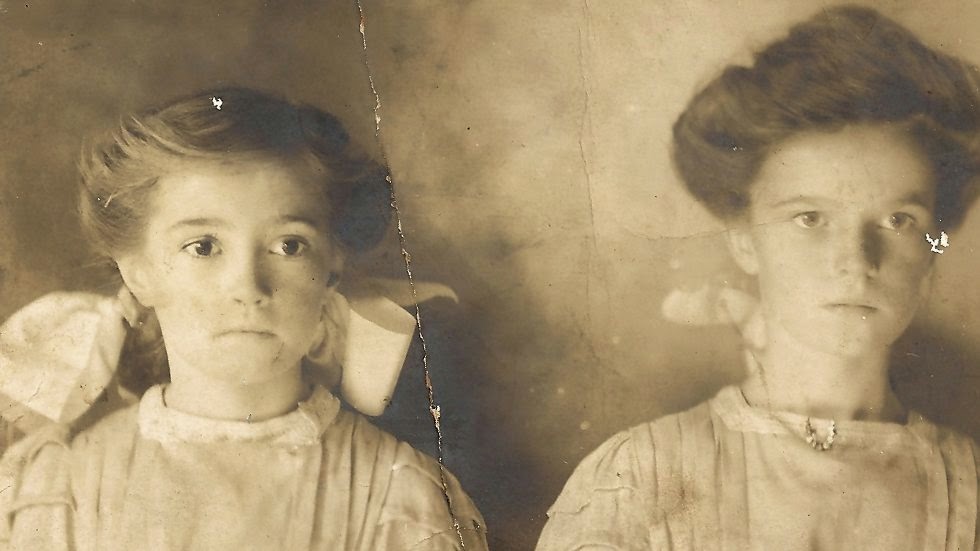
Helen and Vala circa 1907

Vala [her name originally had two l's, but at some point she dropped one] grew up on a small farm near Dunavent in Jefferson County and felt there was never enough money. She liked taking her father's lunch to him in the fields and the dances John and her mother Edith would take her and Helen to. Her father, John, worked as a barber to make ends meet, but then in 1913 when she was 16 he died from injuries from being kicked by a horse. Report of John's injury.


     In November 1915, at the age of 18, Vala began a job as the "Hello Girl," telephone operator in Meriden, Kansas, almost 20 miles from her home near Dunavant. It was while doing this job she first met the delivery boy for the Valley Falls grocery store. She said that she knew his voice before she actually met him. But when they did meet she found him to be a good looking and kind gentleman.
Vala McClenny starts her job as telephone operator - Nov 1915


It's not hard to imagine that their courtship would have included baseball.


Vala and Ray cutting up on the railroad tracks 1916
      By the summer of 1916 Vala would have been at the games to watch the catcher if nothing else. Perhaps this is when she learned her adage that if the home pitcher gets a strike on the first pitch, the home team wins.

The August 3, 1916 edition of The Valley Falls New Era wrote of a game between Valley Falls and Winchester:
On the home grounds last Friday Valley Falls defeated Winchester seven to one .. . .

The feature of the game was the 21 “strike outs” by Stewart. Ten of 21 outs were credited to him. He threw at “spit ball” – anyhow he “spit” on it – which the visitors could not find.
The Winchester boys, one of the best teams in the county when in practice, admitted they were not in form, as they had only played one real game in the season, and came directly out of the field or shop for this game. As one expressed it, “We can’t play ball and work all the time.” Well who can? 
  * * * * * * * * *
In the two hour game, both sides playing slowly in the hot sun, only five errors were made, Winchester 2 and Valley Falls 3. Stewart struck out ten men and Housh four. Bases on balls, Stewart 3, Housh 4. By pitched ball Stewart 3 and Housh none.
Valley Falls fell behind in the second inning giving up a run on a passed ball.  But then in the home half of the fourth: (once again according to the New Era:)
Delk walked on balls and was first to score on a pair of singles, Morgan singled to first and soon scored. Wettig struck out. Father Newman singled to first. Evans flied out to Goddard at 2nd; Zeke McKinney walked, Newman and Newman scored and Lillie flied out to Stoeffler. Four scores.
The score stayed 4-1 until the bottom half of the sixth:


Evans out at first; Stewart knocked a two-bagger and the fun began again. The fans were roaring. Zeke hit a safe onto first and slipped to second. Stewart scored. Lillie singled to first and Zeke scored. Delk lost at first, Morgan and Abe Newman each singled to first and Lillie scored. But Wettig was out at first before Morgan and Abe could get home. Three scores.
 The game was called in the seventh inning when Winchester's latest catcher dislocated a finger.
Vala, Maxine and Edith - 1920 Topeka


It's hard to know if Vala would have been there or not, but she was a baseball fan.

Ray and Vala dated for two years and married in May of 1918 and moved to Topeka. Maxine Marie Morgan was born that Christmas Day.

Wednesday, September 24, 2014

Edward and Betsy Move to Topeka


      Edward Walker and Betsy Sharpe sailed from Liverpool in England about the same time. Edward traveled alone and Betsy with her parents and her nine siblings. Through the fates they both ended up living in Kansas. Edward, according to memories of Edna, worked as a pharmacist in Junction City. Betsy’s youngest sibling, the infant Herbert, died when the family reached Junction City. The Sharpes then decided to homestead in Morris County.
Notice that appeared in the Junction City Union, June 3, 1871


Betsy and Edward married on May 30, 1871 - a date that was two days before Edward's 24th birthday and a month before Betsy's 18th. They setup their home near her parents in Parkerville in Morris County, Kansas. Edward was a well-educated Englishman who had apprenticed in England as an apothecary before deciding to emigrate to the U.S.
Junction City Union, Oct 7 1871

The Walker children circa 1890
from left: Percy, Edna, Lily, Eula, Fred and Grace
Their first child, Edward, lived only nine months, but the children kept coming, starting with the birth of Lily in 1873, and then Fred the following year. By the time Percy was born in 1879 they had moved a few miles north to 160 acres southeast of Dwight. Over the next ten years, four more children were born, Eula, 1884, Grace, 1886 and the twins, Edna and Ethel in May 1888. Edward & Betsy Walker's homestead - Morris County as it appears today

In the late winter of 1889, after almost 18 years of marriage and the births of eight children, Edward and Betsy moved to Topeka from Morris County. Lily and Fred were now teenagers and they wanted to give them a better education than was possible in rural Kansas. 

Edward opened the Walker & Co at 111 East Fifth Street in March of 1889. (Or at least that is when the notices first appear in the Topeka papers.


Council Grove Republican, March 8, 1889


Go to Walker & Co's, druggists No. 111 East Fifth street,
to see the finest twin-babies in the city,
and while there ask for Lactated Food, the best food
in the market for babies - Topeka State Journal, June 12, 1889

     The family moved to the Fifth Avenue Hotel and Edward opened his store, Walker & Co, at 111 East Fifth Street near the post office in Topeka. Unfortunately Ethel Bessie died the following January. 

      More misfortune occurred on Betsy and Edward's 19th wedding anniversary, May 30, 1890. That night Edward locked the store up at 10 o'clock to return home. Shortly after that, the store was on fire. According to the article on page 1 of the Topeka State Journal: 

      The fire was in Walker & Shane’s drug store at 111 E Fifth Street, just opposite the post office. Two or three people in the vicinity saw a blaze suddenly flash up in the rear part of the front room and in half a minute the whole room was ablaze. The fire burned with such intensity that the fire department was unable to do much more than confine it to the one room. The contents of the room were soon totally destroyed and the walls and front of the building were badly burned. The loss is placed by Messrs. E. B. Walker and D E Shane the owners at $3500. The insurance was $2000. The fire was not in progress over thirty minutes. Mr. Walker had locked up and left the building only a few minutes before the fire broke out. He says he is unable to account for it.
This seems to be a fated spot. It was on this site the first fire in the history of Topeka occurred, June 10, 1859. It nearly wiped out the whole city of Topeka which then contained very few houses. It burned up the first corn bought and stored in Topeka. A year ago another fire occurred in the building, doing serious damage.  
      The store reopened in a month, but the partnership between Edward and Mr. Shane dissolved in the fall of 1890. 

      In the week after the fire, Edward became a registered pharmacist - certified by the State Board of Pharmacists.
There were fifty-six applicants for registration and of these an unusually large proportion passed the examination, namely 32. Before being eligible for registration as a complete pharmacist a man must have had four years’ experience of work in a drug store, and to be registered as capable of being an assistant in the are of a pharmacy he must have had two years of experience. Topeka Daily Capital - page 1, June 6, 1890.


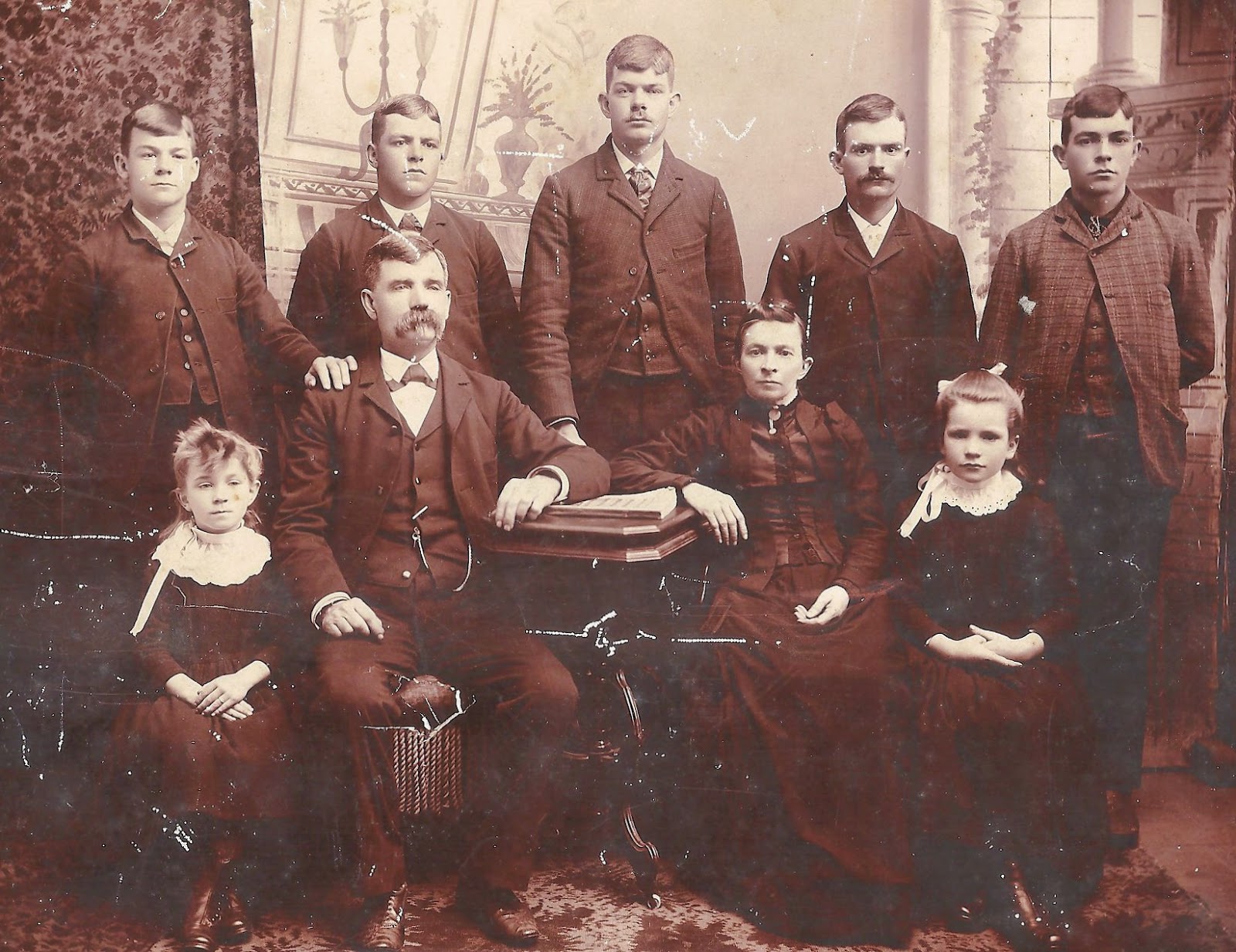
The Edward and Betsy Walker Family circa 1899
Thanksgiving because the store was closed.
Lily, Percy, Edward, Ada, Eula, Betsy, Edna, Fred, and Grace.