Friday, October 17, 2014

Ray and Vala 1916

Ray would have been 8 in 1905.


     Ray Morgan was the fourth child of Elias and Emma Morgan nee Ellingwood and grew up on a small farm in Jefferson County Kansas. His three older siblings had been born in Indiana before the family moved to Kansas. Ray was only six when his father died at the age of 57. Fortunately for Ray, he was able to finish 9 grades of school. At some point, he started working for the D.B.Grocery in Valley Falls as a delivery boy. He gets a mention in the December 16th, 1915 edition of the Valley Falls New Era: The D.-B.Grocery boys have a dandy new delivery wagon in which Ray Morgan is proud to call on their many customers.
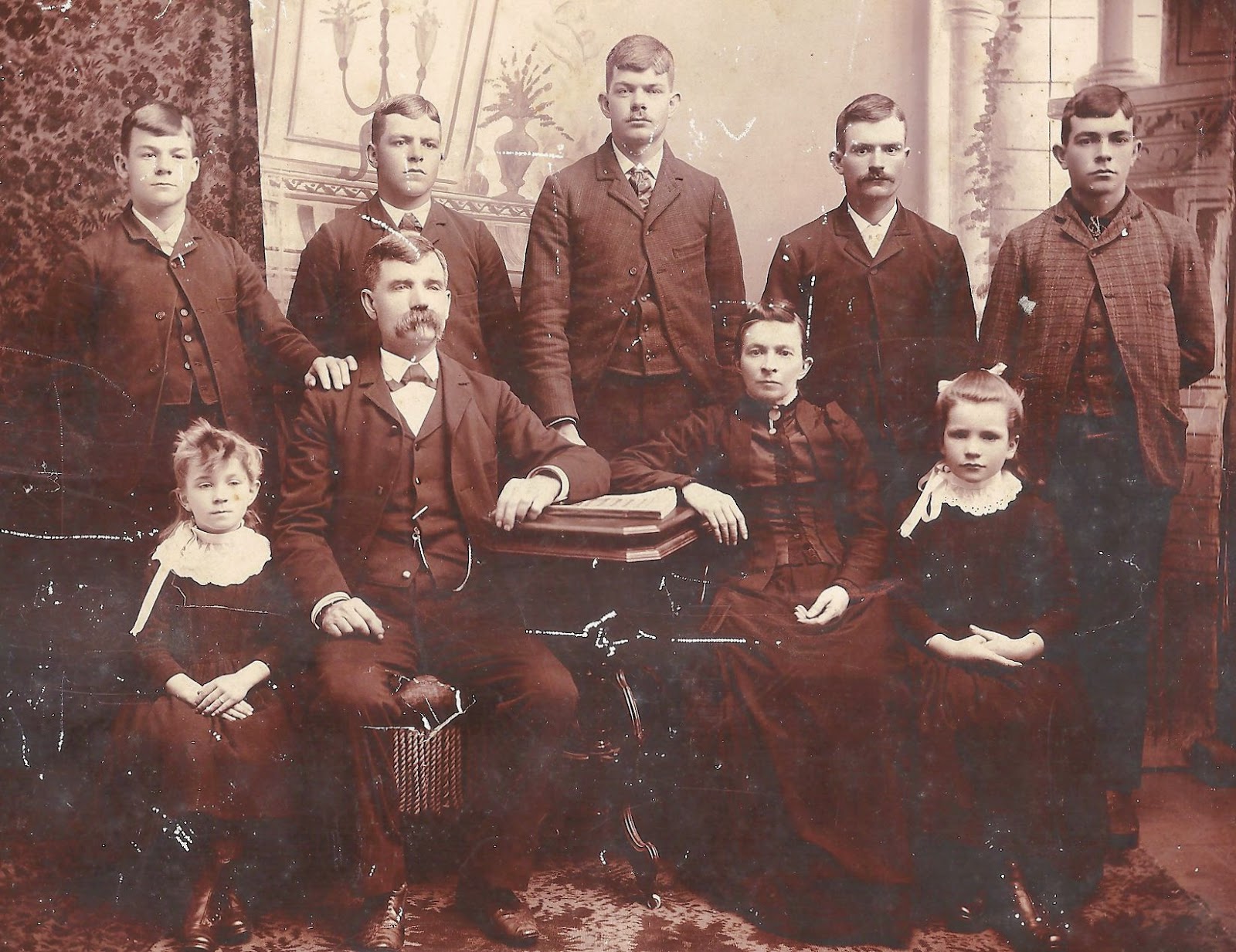
WC and Mary McClenny nee Byram 1889
back row: Barney, Fred, Elias, John (Vala's father) & George
front row: Bess, W. C., Mary and Nelle

       On the other hand, Vala McClenny's grandfather, W. C. McClenny, came to Jefferson County in 1856 at the age of 19. W.C. was a free-soiler who homesteaded and served in the Kansas militia during the Civil War. Brief bio of WC written before 1874 - after clicking on the link, scroll down to the bios. Vala's father was the oldest child of his second wife, Mary Byram.
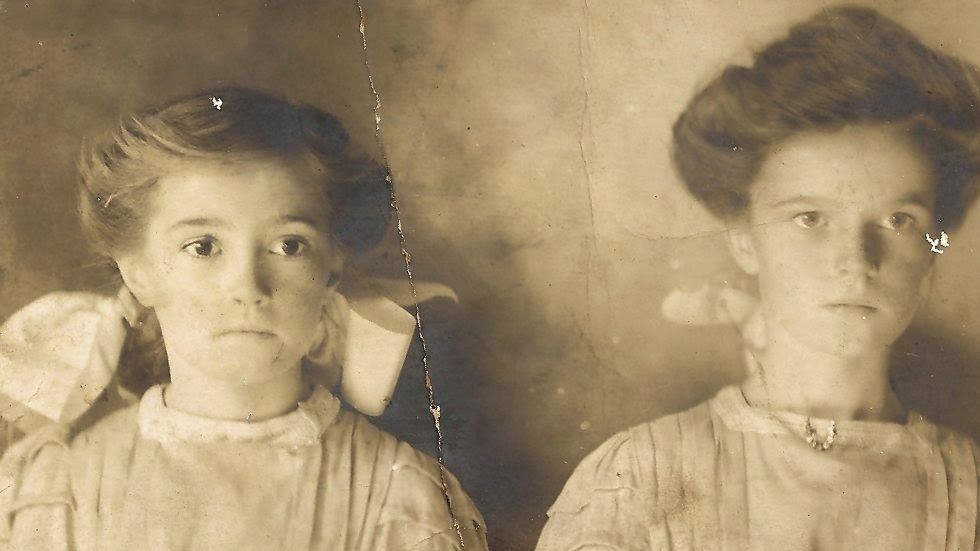


Helen and Vala circa 1907

Vala [her name originally had two l's, but at some point she dropped one] grew up on a small farm near Dunavent in Jefferson County and felt there was never enough money. She liked taking her father's lunch to him in the fields and the dances John and her mother Edith would take her and Helen to. Her father, John, worked as a barber to make ends meet, but then in 1913 when she was 16 he died from injuries from being kicked by a horse. Report of John's injury.


     In November 1915, at the age of 18, Vala began a job as the "Hello Girl," telephone operator in Meriden, Kansas, almost 20 miles from her home near Dunavant. It was while doing this job she first met the delivery boy for the Valley Falls grocery store. She said that she knew his voice before she actually met him. But when they did meet she found him to be a good looking and kind gentleman.
Vala McClenny starts her job as telephone operator - Nov 1915


It's not hard to imagine that their courtship would have included baseball.


Vala and Ray cutting up on the railroad tracks 1916
      By the summer of 1916 Vala would have been at the games to watch the catcher if nothing else. Perhaps this is when she learned her adage that if the home pitcher gets a strike on the first pitch, the home team wins.

The August 3, 1916 edition of The Valley Falls New Era wrote of a game between Valley Falls and Winchester:
On the home grounds last Friday Valley Falls defeated Winchester seven to one .. . .

The feature of the game was the 21 “strike outs” by Stewart. Ten of 21 outs were credited to him. He threw at “spit ball” – anyhow he “spit” on it – which the visitors could not find.
The Winchester boys, one of the best teams in the county when in practice, admitted they were not in form, as they had only played one real game in the season, and came directly out of the field or shop for this game. As one expressed it, “We can’t play ball and work all the time.” Well who can? 
  * * * * * * * * *
In the two hour game, both sides playing slowly in the hot sun, only five errors were made, Winchester 2 and Valley Falls 3. Stewart struck out ten men and Housh four. Bases on balls, Stewart 3, Housh 4. By pitched ball Stewart 3 and Housh none.
Valley Falls fell behind in the second inning giving up a run on a passed ball.  But then in the home half of the fourth: (once again according to the New Era:)
Delk walked on balls and was first to score on a pair of singles, Morgan singled to first and soon scored. Wettig struck out. Father Newman singled to first. Evans flied out to Goddard at 2nd; Zeke McKinney walked, Newman and Newman scored and Lillie flied out to Stoeffler. Four scores.
The score stayed 4-1 until the bottom half of the sixth:


Evans out at first; Stewart knocked a two-bagger and the fun began again. The fans were roaring. Zeke hit a safe onto first and slipped to second. Stewart scored. Lillie singled to first and Zeke scored. Delk lost at first, Morgan and Abe Newman each singled to first and Lillie scored. But Wettig was out at first before Morgan and Abe could get home. Three scores.
 The game was called in the seventh inning when Winchester's latest catcher dislocated a finger.
Vala, Maxine and Edith - 1920 Topeka


It's hard to know if Vala would have been there or not, but she was a baseball fan.

Ray and Vala dated for two years and married in May of 1918 and moved to Topeka. Maxine Marie Morgan was born that Christmas Day.

Wednesday, September 24, 2014

Edward and Betsy Move to Topeka


      Edward Walker and Betsy Sharpe sailed from Liverpool in England about the same time. Edward traveled alone and Betsy with her parents and her nine siblings. Through the fates they both ended up living in Kansas. Edward, according to memories of Edna, worked as a pharmacist in Junction City. Betsy’s youngest sibling, the infant Herbert, died when the family reached Junction City. The Sharpes then decided to homestead in Morris County.
Notice that appeared in the Junction City Union, June 3, 1871


Betsy and Edward married on May 30, 1871 - a date that was two days before Edward's 24th birthday and a month before Betsy's 18th. They setup their home near her parents in Parkerville in Morris County, Kansas. Edward was a well-educated Englishman who had apprenticed in England as an apothecary before deciding to emigrate to the U.S.
Junction City Union, Oct 7 1871

The Walker children circa 1890
from left: Percy, Edna, Lily, Eula, Fred and Grace
Their first child, Edward, lived only nine months, but the children kept coming, starting with the birth of Lily in 1873, and then Fred the following year. By the time Percy was born in 1879 they had moved a few miles north to 160 acres southeast of Dwight. Over the next ten years, four more children were born, Eula, 1884, Grace, 1886 and the twins, Edna and Ethel in May 1888. Edward & Betsy Walker's homestead - Morris County as it appears today

In the late winter of 1889, after almost 18 years of marriage and the births of eight children, Edward and Betsy moved to Topeka from Morris County. Lily and Fred were now teenagers and they wanted to give them a better education than was possible in rural Kansas. 

Edward opened the Walker & Co at 111 East Fifth Street in March of 1889. (Or at least that is when the notices first appear in the Topeka papers.


Council Grove Republican, March 8, 1889


Go to Walker & Co's, druggists No. 111 East Fifth street,
to see the finest twin-babies in the city,
and while there ask for Lactated Food, the best food
in the market for babies - Topeka State Journal, June 12, 1889

     The family moved to the Fifth Avenue Hotel and Edward opened his store, Walker & Co, at 111 East Fifth Street near the post office in Topeka. Unfortunately Ethel Bessie died the following January. 

      More misfortune occurred on Betsy and Edward's 19th wedding anniversary, May 30, 1890. That night Edward locked the store up at 10 o'clock to return home. Shortly after that, the store was on fire. According to the article on page 1 of the Topeka State Journal: 

      The fire was in Walker & Shane’s drug store at 111 E Fifth Street, just opposite the post office. Two or three people in the vicinity saw a blaze suddenly flash up in the rear part of the front room and in half a minute the whole room was ablaze. The fire burned with such intensity that the fire department was unable to do much more than confine it to the one room. The contents of the room were soon totally destroyed and the walls and front of the building were badly burned. The loss is placed by Messrs. E. B. Walker and D E Shane the owners at $3500. The insurance was $2000. The fire was not in progress over thirty minutes. Mr. Walker had locked up and left the building only a few minutes before the fire broke out. He says he is unable to account for it.
This seems to be a fated spot. It was on this site the first fire in the history of Topeka occurred, June 10, 1859. It nearly wiped out the whole city of Topeka which then contained very few houses. It burned up the first corn bought and stored in Topeka. A year ago another fire occurred in the building, doing serious damage.  
      The store reopened in a month, but the partnership between Edward and Mr. Shane dissolved in the fall of 1890. 

      In the week after the fire, Edward became a registered pharmacist - certified by the State Board of Pharmacists.
There were fifty-six applicants for registration and of these an unusually large proportion passed the examination, namely 32. Before being eligible for registration as a complete pharmacist a man must have had four years’ experience of work in a drug store, and to be registered as capable of being an assistant in the are of a pharmacy he must have had two years of experience. Topeka Daily Capital - page 1, June 6, 1890.


The Edward and Betsy Walker Family circa 1899
Thanksgiving because the store was closed.
Lily, Percy, Edward, Ada, Eula, Betsy, Edna, Fred, and Grace.

Thursday, September 18, 2014

Curtis and Otis Get Involved in a Set-to

John and Edith McClenny raised their four children on a farm near Dunavant, KS, a small town in Jefferson County near Topeka. Their children were the two boys, Curtis and Otis, born respectively in 1891 and 1893, and the two girls,  Vala and Helen, born in 1897 and 1900. In the summer of 1913, John was kicked in the head by one of his horses and lingered for a month before dying in September.

In November 1915, the Valley Falls New Era ran the following article:    
Curtis, on the left, and Otis McClenny, pictured in 1917.
The matter of keeping Otis and Curtis McClenny under a peace bond came up before Judge Raines Monday, and the boys were discharged. [The boys were 24 and 21]
A month or two ago Marion Smith, of southeast Valley Falls, went before Justice of the Peace Lord at Valley Falls and swore to a complaint that these two boys had threatened his life and that he was in fear they would carry out their threat and asked that they be put under a peace bond. This Justice Lord did, fixing the bond at $500 each and the bonds, duly executed were filed with the Clerk of the Court. The matter of hearing whether or not these bonds should be continued came up for hearing Monday as noted above. 

 It seems the whole trouble between these parties started over the fact that some of the McClenny’s hogs had gotten into Smith’s corn and some of Smith’s chickens had gotten into the McClenny’s wheat. The matter of damages to the two crops was settled some time ago after the property had been appraised. At the time the McClenny’s came to the Smith home to get their hogs, which had been taken up by Smith, a quarrel ensued in which the boys “invited Smith out into the road saying they would brain him.” 
Gladys McClenny nee Jones 1907
Later when the boys were returning some tools they had borrowed from Smith he alleged they had threatened to murder him. And again, later, when Curtis McClenny came to the Smith home with a check in payment for the damage done to his corn a quarrel started which ended in Smith throwing a large stone (the stone was introduced in evidence) at the McClenny boy; and the two clinched and at this time Smith says he stated that “if my brother [Otis] was here, we’d murder you.” 
The court, after hearing denials from the boys and their witnesses, decided that he could not believe that the boys intended to injure Mr. Smith and accordingly dismissed them. 

The McClenny boys were farming some of Smith’s land at the time of the trouble. The court, in rendering his decision, stated that in his opinion the case was one for the county attorney and that the Justice of the Peace had not jurisdiction in the matter, any more so than he (the Judge) would have, had Mr. Smith appealed to him in the first place; and that instead of the boys being put under a peace bond in view of the testimony, it looked like it should have been a case against Smith on grounds of assault and battery; (he having thrown a stone at the boy.)
Glenna and Ferol McClenny nee Howard 1917
      Within a year the McClenny boys had each married and moved to Topeka.


Wednesday, September 3, 2014

Ray Morgan Plays Base Ball - August 30, 1914

 
   One hundred years ago, 18-year old Ray Morgan played catcher for the Valley Falls team. The following is the story as it appeared on Thursday, September 3, 1914 in The Valley Falls New Era.

The best ball game ever pulled off on the Valley Falls diamond was the one played last Sunday when the Home Team won, 5 to 2, against the fast Winchester team.

For three and a half innings not a score was made. None had reached first base, except Ray Morgan in the third.

There was tense anxiety in the grandstand. Something would happen. And it did.

McKinney sent the ball over the fence in right and landed safely on third. Everybody shouted. Harding followed with another three base hit, scoring McKinney. Delk got a hit and scored Harding. In the fifth and sixth there was nothing doing. The Home team was 2 to the good. In the 7th Goddard scored one for the visitors. Our boys drew a blank. In the 8th Yeck scored another for Winchester tieing the score. Now it was anybody’s game.

But when the Home team went to bat they faced a new pitcher—though Housh had been doing fine, Stoeffler taking the mound. And that’s where our boys forged ahead, knocking out three scores. How the fans shouted! And so it ended 5 to 2. It was a great game. The winner took all the receipts, by previous agreement.


R
H
E
Winchester
0
0
0
0
0
0
1
1
0
2
6
2
Valley Falls
0
0
0
2
0
0
0
3
X
5
6
1


Line Up
Valley Falls
R
H
E
Newman, lf
0
0
0
Lillie, ss
1
0
0
Chapman, 3b
1
2
0
McKinney, rf
1
2
0
Harding, p
1
1
0
Delk, 1b
0
0
1
Evans, 2b
0
0
0
Morgan, c
0
1
0
Figgs, cf
1
0
0

5
6
1


Winchester
R
H
E
Royer, 3b
0
1
0
Wallace, 1b
0
1
0
Goddard, 2b
1
1
0
Stoeffler, ss
0
1
1
Thomas, cf
0
0
1
Kiernan, c
0
1
0
Thompson, rf
0
0
0
Yeck, lf
 1
0
0
Housh, p
0
1
0

2
6
2

Struck out by Housh 10; by Harding 11. Batteries for Winchester Housh and Kiernan; for Valley Falls, Harding and Morgan. Umpire Triggs. Time 2 hours.
The fast Mayetta Indians will come for a game next Sunday.

Winchester is a small community about 12 miles east of Valley Falls. It's tricky to read the box score because the hits and runs are to me reversed.
Ray Morgan 1916

Wednesday, August 20, 2014

Ceremonial Cave - Bandelier 1959

In 1959 Ray decided that we five needed to see more of the world and get up close and personal with nature. To him this was best achieved by camping. It's a long story and it has been written about. But let me write just a tad more about it.

For me, and for most of us, the favorite part of the trip was the time we spent in Bandelier. It was peaceful, it wasn't hot and, may I say it again, it was peaceful. One afternoon Dad took Steve, Sally and me on a short hike to climb up to Ceremonial Cave. The following is the article Ray wrote for the Kansas City Star that was published on March 23, 1962 - almost 3 years after the event.

Ojoaque, NM – There was a thundershower falling down through Los Frijoles canyon and two large black ravens flapped noisily along as my three older children and I sat in the Indian ceremonial cave several hundred feet above the canyon floor.

It was an afternoon that both they and I will remember as the brief rain shower among the ruins occupied by the Indians more than 700 years ago here in Bandelier National Monument, a living remnant of a civilization long gone.

The sun had been shining when the four of us started out along the trail lined with pine trees and running along the bed of the tumbling Los Frijoles Creek. We were on our way to visit the Ceremonial cave still preserved as it was when the Indian priests used it centuries ago.
By the time Steve, Susan and Sally and I were two-thirds of the way to our destination, clouds had begun to roll in over the canyon edge and the rumble of distant thunder could be heard.

We reached the point in the trail where the ascent up the cliff face to the old ceremonial cave, in use in the 1200s, begins.
High above us in the canyon wall, consisting largely of tuff, a form of consolidated volcanic ash, was the half-moon entrance to the cave. For a time the trail led up over the basaltic lava boulders ejected thousands of years ago from the great volcanic crater – perhaps the largest in the world – whose rim today forms the Jimez Mountains.
From there on a series of large timber ladders, whose rails are as large as telephone poles, have been installed by the National Park Service. We started up the ladders with Steve first, followed by the two girls and myself.
We inched our way up the ladders until we reached the cave entrance. Then we stepped inside onto the dusty floor. The ceiling and walls were blackened with the smoke of numerous ceremonial fires. Indian petroglyphs were etched into the walls.
In the floor of the cave, there was a large circular hole marking the entrance to the kiva, the chamber used as a ceremonial council room by the elders of the community. The views across the canyon with its tall pines and the plateau stretching on beyond was magnificent.
No sooner had we become situated than the rain began to fall. There was talk about being trapped up here for days. Thoughtfully, we sat in the cave entrance and munched on chocolate bars.
Bandelier is a place where time stands still. An area on the upper Rio Grande river valley of New Mexico 46 miles west of Santa Fe, it consists of the Frijoles and Otowi sections and is mostly a wilderness crossed only by trails. 
Cliff ruins of talus villages extend along the base of the northern wall of the canyon approximately two miles. These houses of masonry were irregularly terraced, from 1 to 3 stories in height, and had cave rooms gouged out of the solid cliff.
In front of the caves is the ruined pueblo of Tyuonyi on the floor of the Frijoles canyon. It is a large structure of nearly circular plan with three kivas in an enclosed plaza. The structure contained more than 400 rooms and rose to 4-story height. 


The large community house was excavated in 1908, 1909 and 1910 by the Museum of New Mexico and the School of American Research. Mary, I and the children had delighted in walking among its ruins.
Tree ring chronology and correlations of pottery types indicate that most of Bandelier’s ruins belong to the late pre-conquest period, although a few small ruins date back to the 12th century. The large pueblos of Tyuonyi, Tsankawi and Otowi evidently were occupied until about 1550 AD although their decline had probably set in by the time Coronado visited the region in 1540.
With the passing years, drought, soil-eroding, flash floods, soil depletion, raiding Indians, famine, disease—any of these things singly or in combination might have caused the beautiful area, a veritable oasis in the dry country of New Mexico, to be abandoned.
As we sat in cave, the thunder peals resembled the throb of the drums we had heard the night before as we sat around a huge campfire on the canyon floor. National Park rangers had brought Indians in from a nearby Pueblo to chant and drum as the women did corn grinding ritual.
But, as happens in these mountains, the rain passed on and the sun came out as the last few drops were falling. A rainbow arched its way across the canyon. The display of color made it easy to understand why Indian sachem of a bygone era had this spot as something sacred.
With the spell broken, we took one last look around cave and began our descent. Once again on the canyon floor, the scent of the pines hung heavily and sweetly in the air, brought out more strongly by the rain. Rio de Los Frijoles, the canyon creek, cascaded and boomed more strongly, swollen by the water from the newly-fallen downpour.
Mary, my wife, and Cindy and Scott, the two younger children, were waiting anxiously for us as we came back to the campsite from our adventure. Bandelier, a spectacular beauty, would remain etched in our memory for years to come.

When I returned to Bandelier National Monument in 1986, the campground we'd stayed in had been converted to a picnic area. But overall it was as I remembered. Although when Lee and I tried to ascend the ladders to Ceremonial Cave, we made a joint decision to not go all the way. I guess it says something, but I'm not sure what, about how you change throughout life.
Debbie and Drew climb into Ceremonial Cave in 1991.

Five years later, thanks to Chris's broken arm, Lee and I returned to Bandelier with our four children. Debbie and Drew made the climb to Ceremonial Cave, but the rest of us watched from the canyon floor.

In recent years Bandelier has suffered fires and floods, but appears to be trying to carry on. Ceremonial Cave is now called Alcove House.
Chris broke his arm in Red River, had it x-rayed in Taos and set in Los Alamos.
.

Sunday, July 13, 2014

The KU J-school assignment - 40 years apart


     A couple of weeks ago, the boys and I traveled to Lawrence for some housekeeping chores. When we were finished with the chores, we walked to the KU campus to visit the Natural History Museum. As we walked up the steps to Dyche Hall, a young woman approached us and asked if she could photograph us visiting the museum. She said she had a photography assignment for a journalism class.
Lawrence Park winter 1970-71
     We said we had no problem with that and she was so unobtrusive the boys and I soon forgot that she was there. But it did take me more than 40 years ago when I took my one journalism photography course here at KU. The biggest difference, of course, would be the equipment we each used. The current J-School student could shoot in the low light of the museum without any problem. When I took the class, I used a light meter separate from the camera and did everything manually.
Sally throws a Frisbee through a car window at Nieman School 1970
Contact sheet of photos I took for class
The photos in this blog are from those assignments almost 45 years ago. I hadn't seen these for several decades, but I'm still happy with them. I'm probably still too proud of them mainly because I can't remember my grades.
Scott and his trombone
    I liked the class, the instructor not so much. It took a lot of time and unlike writing, it involved actual time of doing things, shooting the photos, developing them and finding out they weren't in focus and the perfect photo was probably a smidge over. In contrast writing was a lot of time, sitting and staring and then putting something down on paper. Writing seemed like the way I might have the most success.
Chris Jensen shoots the ball in the backyard at the Topeka house on Jewell.
I didn't share any of this with the young woman that day - thought it was probably more than she wanted. If I could do it again, with instant results from the photography, I'm not sure which I would choose. Probably would still be writing.

Sunday, June 1, 2014

Edward Walker's Niece and the Blitz


     The Liverpool-Merseyside blitz is the forgotten blitz of World War II, or in my case, unknown. I hadn't realized that areas outside of London were systematically bombed by the Germans. I do remember Mary Grace saying that during World War II some of the Walker relatives might send their children to Kansas. I thought that meant they lived in London. But they did not, they lived inn Birkenhead now called  Merseyside. This is a link to the Merseyside area

Russia Hall - Edward's home for about 10 years, but it remained the Walker family home for more than a century.


Edward Walker, Edna's father, was the second son and fifth child of Thomas and Mary Walker. As the second son, Edward believed his prospects were better in America. Edna remembered her father saying he was the black sheep of the family - probably because he was the only one of his eight siblings to leave the British Isles.
   

    Edward's family may have been thousands of miles away, but he kept in touch. Edna thought he'd made at least three return trips to visit Russia Hall including one in 1898 when he took Betsy with him. A letter written in 1961 from Ada Walker Smith to Laura Leib mentions that Betsy enjoyed the Walker family when she visited them. She especially enjoyed Ann, Edward's younger sister by three years, and her daughters. Ann had five daughters and one son. The one letter from Ann that survives, written in 1917, mentions the possibility of one of the daughters coming to Kansas to attend Washburn.


Ann Walker, dark dress, front row at her daughter Etta's marriage to John Richard Leach in 1909.
     Edna at her marriage to EA in 1913 wore Etta's veil.

From left: Bill Smith, Delphia Burkhardt, EA, Edna, Ada, Grace, Eula and Fred.
Back row: Henry Thayer, Jenny Thayer Walker, Bud, Betsy, Frank Faust, George Bale
Front row: Dorothy Leib & ?
   Here is the letter from Ada to Laura in 1960 or 1961 in which I learned about the cousin being killed in a raid.
Laura, I am sending this letter that tells about the school in Chester which Dorothy wanted to read. The lady who wrote of it is my first cousin her mother was father’s sister. This girl is the one who painted the picture of our fathers’ home which you saw in our dining room. Her husband is dead but she lives near another cousin of mine named Mary and her husband is living. The Joyce who she speaks of is the only child of their sister who was killed in a raid during the war. She and her husband were both killed. There were three girls in this Croston family and mother liked them so well when she met them while in Europe. Return this letter when you have perused same.  

       The Germans began the bombing of Liverpool in August 1940. During the first week of May 1941 nearly 700 planes dropped 870 tons of high explosives and 112,000 firebombs were dropped on Liverpool and the surrounding area docks. More than 1500 people died. The last blitz was on January 10, 1942. The Liverpool area had the highest death toll of any area outside of London.

      As mentioned earlier, Ann Walker had five daughters: Sarah, Mary, Henrietta - Etta, Isabella and Lalla. According to records I've found Isabella Munro Hodgson died September 27, 1943 and her husband Edwin died in 1945. Those years are outside the dates of the bombings, but I assume they could have died from injuries suffered during the blitz.
   
The area around Lord Street and Castle Street was severely damaged. 3/4 May 1941

Ann Walker's children from left:
Charles Younger, Isabella Croston, ? Etta Croston, John Leach and Lalla Croston
pictured at Etta's wedding to John Leach in 1909.